


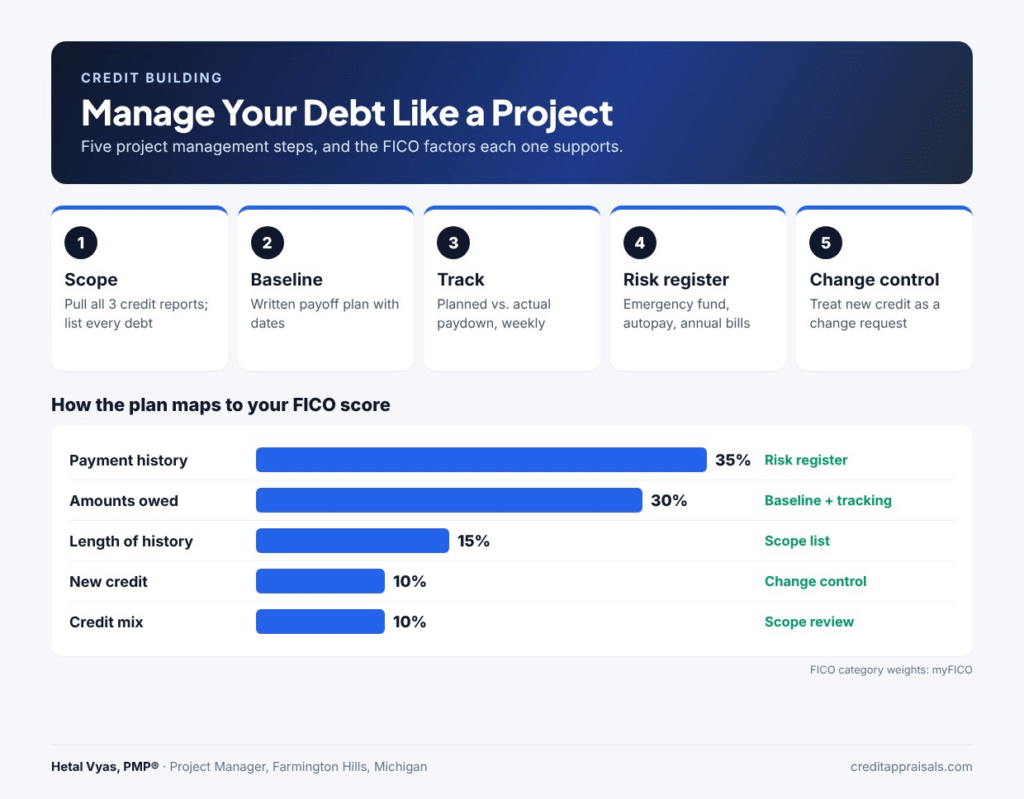
You can improve your credit the same way a project manager delivers a project: define the scope (pull your credit reports and list every debt), set a baseline (a written payoff plan with dates), track planned versus actual progress every week, keep a risk register for things that could knock you off course, and control changes such as new credit applications. Hetal Vyas, a PMP-certified project manager in Farmington Hills, Michigan, has spent more than 30 years keeping manufacturing projects on schedule and on budget, and the same disciplines line up closely with the factors that drive a FICO score.
Most people treat credit repair as a wish: pay things down, hope the score goes up. Project managers would never run a project that way. They set a scope, a budget and a schedule, measure progress against the plan and deal with risks before they become problems.
That mindset is what Hetal Vyas has applied to manufacturing projects for three decades. This article borrows his project management toolkit and applies it to a goal many readers share: paying down debt and building stronger credit.
This article explains general project management methods applied to personal finance. It is not individual financial advice; for decisions about your situation, consult a qualified financial professional.
Who Is Hetal Vyas?
Hetal Vyas is a project manager at Bosch in Farmington Hills, Michigan, where he focuses on safety and compliance. He holds the Project Management Professional (PMP)® certification and a Bachelor’s degree in Business Management from Michigan State University. Before Bosch, he worked at General Motors for twelve years, then at Whirlpool and Magna International, where his work centered on process optimization, cost reduction and keeping projects on time and on budget.
He also hosts a project management podcast whose episodes cover budgeting topics such as cost baselines, budget variances and the cost performance index. Those same ideas translate surprisingly well to a household budget.
Why Does Improving Your Credit Work Like a Project?
A project has a defined goal, a deadline, limited resources and risks. So does a credit plan. Your goal might be a score high enough for a better mortgage rate. Your deadline might be a home purchase in 18 months. Your resources are the money you can put toward debt each month. And the risks are everything that could interrupt the plan, from a car repair to a rate increase.
Thinking of it this way changes the question from “How do I fix my credit?” to “What is my plan, and am I on track?

Step 1: Define the Scope by Pulling Your Credit Reports
Every project starts by defining what is in scope. For credit, that means knowing exactly what lenders see. Equifax, Experian and TransUnion permanently made free weekly credit reports available in 2023 through AnnualCreditReport.com, the official site for free reports.
Pull all three, check each for errors and list every account in one place:
| Account | Balance | Credit limit | Interest rate | Minimum payment | Due date |
|---|---|---|---|---|---|
| Credit card A | $4,200 | $6,000 | 24.9% | $126 | 5th |
| Credit card B | $1,100 | $3,000 | 19.9% | $35 | 18th |
| Auto loan | $9,800 | n/a | 7.4% | $310 | 22nd |
The figures above are an example. Your own list is your project scope: nothing gets left out, and nothing gets forgotten.
Step 2: Set a Baseline With a Written Payoff Plan
In project management, the baseline is the approved plan you measure against. Without one, there is no way to know whether you are ahead or behind. For debt, the baseline is a month-by-month payoff schedule.
Start with what you can reliably put toward debt each month after essentials. Then choose an order of attack:
- Avalanche method: pay minimums on everything, put extra money toward the highest interest rate first. This usually costs the least in total interest.
- Snowball method: put extra money toward the smallest balance first. Quick wins can help people stay motivated.
Either works if you stick to it. Write the plan down with target dates for each account, the same way a project schedule has milestones.
Step 3: Track Planned Versus Actual Every Week
This is the habit that separates projects that finish on budget from those that do not. Vyas explains the project version in his guide to earned value basics: compare what you planned to finish, what you actually finished and what you actually spent.
The household version is simpler. Once a week, compare:
- Planned paydown to date, from your baseline
- Actual paydown to date
- New charges added since the plan started
If actual paydown is behind plan, you see it in week three rather than month nine, while it is still easy to correct.
Step 4: Keep a Risk Register for Your Finances
Project managers keep a list of things that could go wrong, rate each one and plan a response before it happens. A personal finance risk register might include:
| Risk | Likelihood | Impact | Planned response |
|---|---|---|---|
| Car repair | High | Medium | Build a small emergency fund first |
| Annual bills (insurance, registration) | Certain | Medium | Set aside a monthly amount |
| Rate increase on a variable card | Medium | Medium | Prioritize that balance |
| Missed due date | Medium | High | Turn on autopay for at least the minimum |
The last row matters most. Payment history is the largest single factor in a FICO score, so protecting on-time payments is the top priority of the whole plan.
Step 5: Control Changes, Especially New Credit
On a project, uncontrolled changes (“scope creep”) are a leading cause of overruns. In a credit plan, the equivalent is opening new accounts or adding new spending mid-plan. New credit applications create inquiries and can affect your score, so treat each one as a change request: does it serve the goal, and is this the right time? If you are rebuilding from a thin or damaged file, compare options on the personal credit and credit cards pages before applying.
How the Plan Lines Up With Your FICO Score
According to myFICO, FICO scores are built from five categories. Each step of the plan supports at least one:
| FICO category | Weight | Project step that supports it |
|---|---|---|
| Payment history | 35% | Risk register (autopay, due-date tracking) |
| Amounts owed | 30% | Baseline payoff plan and weekly tracking |
| Length of credit history | 15% | Scope list (keep older accounts in good standing) |
| New credit | 10% | Change control on applications |
| Credit mix | 10% | Scope review of account types |
Does This Work for Business Credit Too?
Yes, and arguably even better. Small business owners already run projects: product launches, equipment purchases, new locations. Applying a baseline, weekly tracking and a risk register to business debt keeps cash flow predictable and supports a stronger business credit profile when it is time to borrow. See the business credit section for funding options.
Frequently Asked Questions
How can project management help improve my credit score?
Project management adds structure: a defined list of debts, a written payoff plan, weekly tracking against that plan, a list of risks with planned responses and control over new credit applications. That structure supports the factors that matter most to credit scores, especially on-time payments and lower balances.
Who is Hetal Vyas?
Hetal Vyas is a PMP-certified project manager at Bosch in Farmington Hills, Michigan, with more than 30 years in manufacturing at General Motors, Whirlpool, Magna International and Bosch, focused on safety, compliance and on-budget delivery.
What matters most in a FICO score?
Payment history, at 35 percent, followed by amounts owed at 30 percent, according to myFICO. Length of credit history, new credit and credit mix make up the rest.
How often can I check my credit report for free?
Weekly. Equifax, Experian and TransUnion made free weekly reports permanent in 2023 through AnnualCreditReport.com.
Should I use the avalanche or snowball method?
The avalanche method usually saves the most interest; the snowball method can be easier to stick with. The best choice is the one you will follow consistently.